SLIPS Rules
This is where things get interesting! More opportunity to bluff and greater risk/reward!
Here are the special rules that make SLIPS addicting:
1. 2nd chance Bid
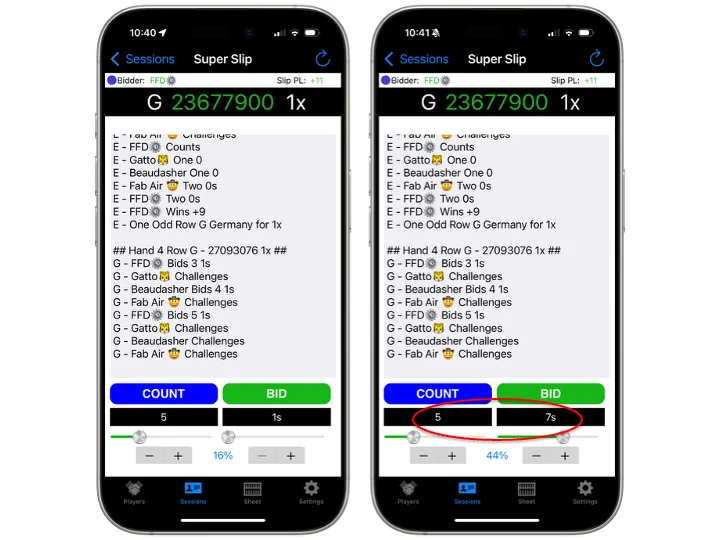
Once everyone has challenged a bid the bidder has the option to either Count or make a higher bid. If a 2nd bid is made and challenged around again without higher bids from any of the other players, a Count is forced.
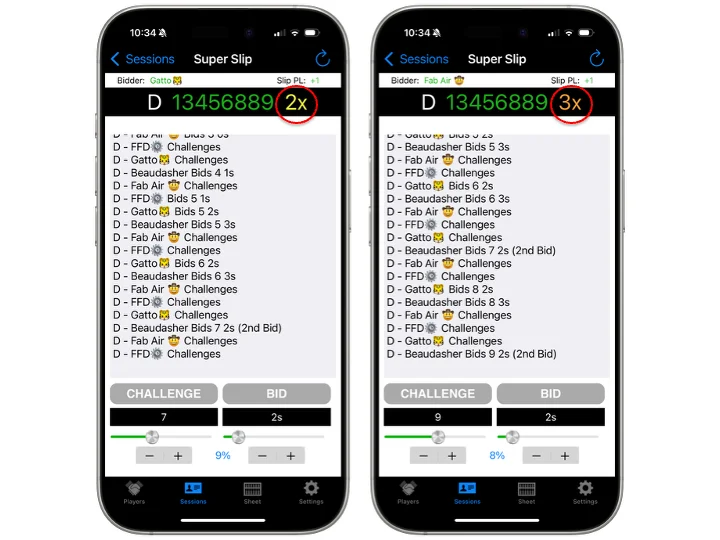
2. Level Multiple
The potential payout on a successful bid increases with the bid level. It goes double (2x) at 3 more than the number of players, triple (3x) at 5 more, quadruple (4x) at 7 more and so on. For example in a 4-player game shown below a successful bid at the 7 level, 7 2s, pays double, 9 2s pays triple, and 11 2s pays quadruple. Note this accretes to a successful bidder, 2, 3 or 4 units from each other player. However, if the bid is not made the bidder only pays out the base multiple (1 unit here) to each other player – risk/reward in action!
3. Sixes Multiple
Any bid of the number 6 doubles the stakes. In our 3-player example, a successful bid of 5 6s pays double, while 6 6s pays quadruple (2x for 6s plus 2x for the level at 3 more than the number of players) and 8 6s pays 6x. Again, as with the Level Multiple this is an asymmetrical payout for a successful bid – a losing bid only pays out the incoming stakes. Also, if the bid moves to another digit, say from 5 6s to 5 8s, the Sixes Multiple comes off.
4. Base Multiple
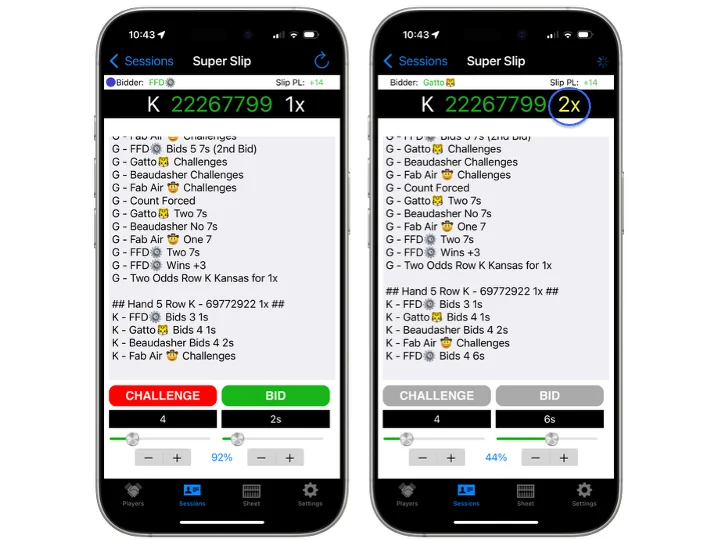
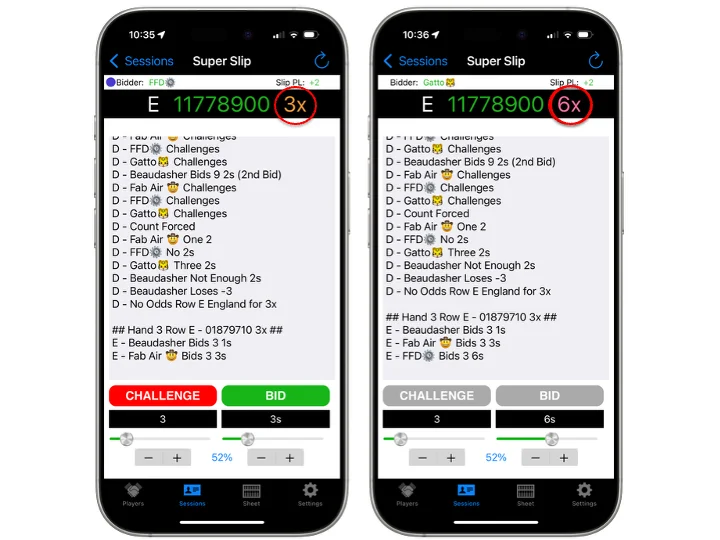
A new hand starts out with a multiple based on where the last hand ended. So if the last hand went out as a triple, the new hand starts as a triple and potentially increases from there via the Level or Sixes multiple. These are the really big hands!
5. Final Hand Doubled
The Base multiple for the 10th and final hand in a Slip is always doubled, so whatever the multiple is coming out of the 9th hand times 2. A single becomes a double (2x), a double becomes a quad (4x), a triple becomes a sixtile (6x), a quad an octal (8x) and so on.
6. None and Hero Bids
Another crafty way to try throwing off the opposition is to bid on a digit you have none of in your hand. Based on the number of players, you can actually win if none of the hands contain that digit or, if the bid happens to be successful (meaning all other players have enough or more of that digit), win what’s known as a Hero bid.
In 2-player a None bid doesn’t apply, in 3-player it’s a tie, in 4-player it pays double (2x), all based on the formula 2n-6 where n is the number of players. Obviously the more players the less likely it is statistically, hence the higher payoff. A Hero pays off differently, adding 1x to the Level multiple. All hands following a None bid are automatically a double (2x) unless it’s the tenth hand, where it’s 4x.
As you can probably tell, these features serve to potentially produce large swings in profit/loss along with a high degree of entertainment. Asymmetric payouts incent bidders to step up and variable stakes from one hand to the next keeps everyone engaged. Big hands that make or break a Slip invariably appear and require additional nerve, wits and perhaps a bit of luck too.